The problem
Accounts-receivable teams may need to manage hundreds or thousands of open invoices without knowing which ones are most likely to be paid late.
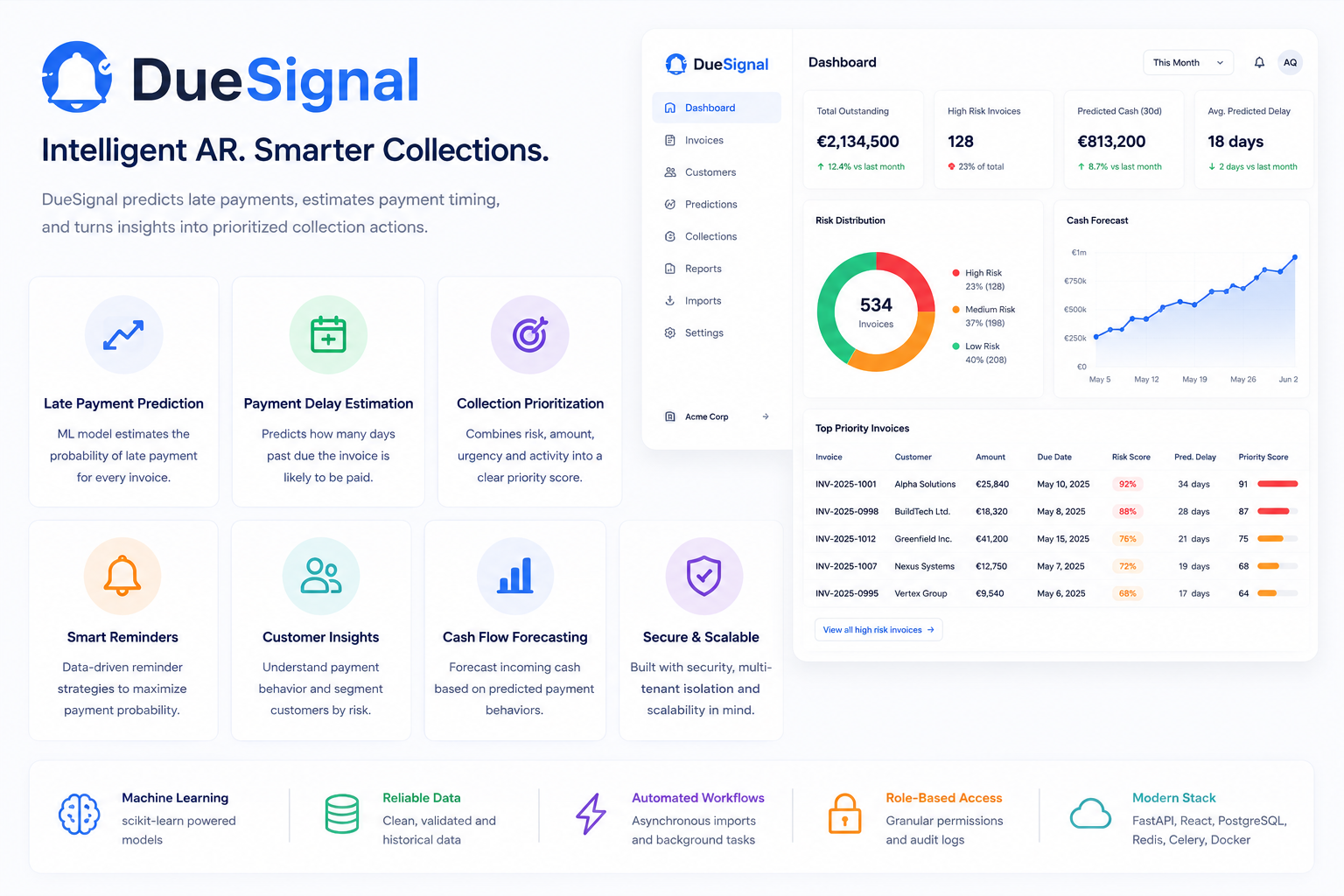
Treating every invoice equally wastes collection capacity. DueSignal is designed to identify risk early and convert that risk into a clear operational queue.
My approach
DueSignal uses two related machine-learning models:
- A classifier estimates the probability that an invoice will be paid late.
- A regressor estimates payment delay relative to the due date.
The system separates issue-time model features from live operational signals. This prevents current overdue status, future reminders, and final payment information from leaking into model training.
Data preparation
The import pipeline validates identifiers, invoice amounts, currencies, issue dates, due dates, and payment dates before records become training examples.
Customer-history features are reconstructed as of each invoice’s issue date. Only outcomes known before that date are included.
Validation
The latest portion of resolved invoices forms the evaluation period. Earlier invoices form the training period.
This chronological split reproduces the real deployment direction: train on the past and predict future invoices.
The classifier is evaluated using:
- ROC-AUC for ranking quality
- Brier score for probability quality
- Calibration analysis
- A constant-probability baseline
The regression model is evaluated using mean absolute error and a median-delay baseline.
Turning predictions into decisions
The final collection score combines:
- Late-payment probability
- Invoice amount percentile within its currency
- Due-date urgency
- Reminder pressure
Keeping this formula separate from the model makes business policy adjustable and allows users to understand why an invoice appears near the top of the queue.
Architecture
The application separates the frontend, API, application services, background workers, persistence layer, and machine-learning pipeline.
This makes imports and model training asynchronous while keeping the API responsive.
Current status
The main application modules are implemented. The next steps are to complete production evaluation, publish final model metrics, expand monitoring, and collect feedback from potential users.